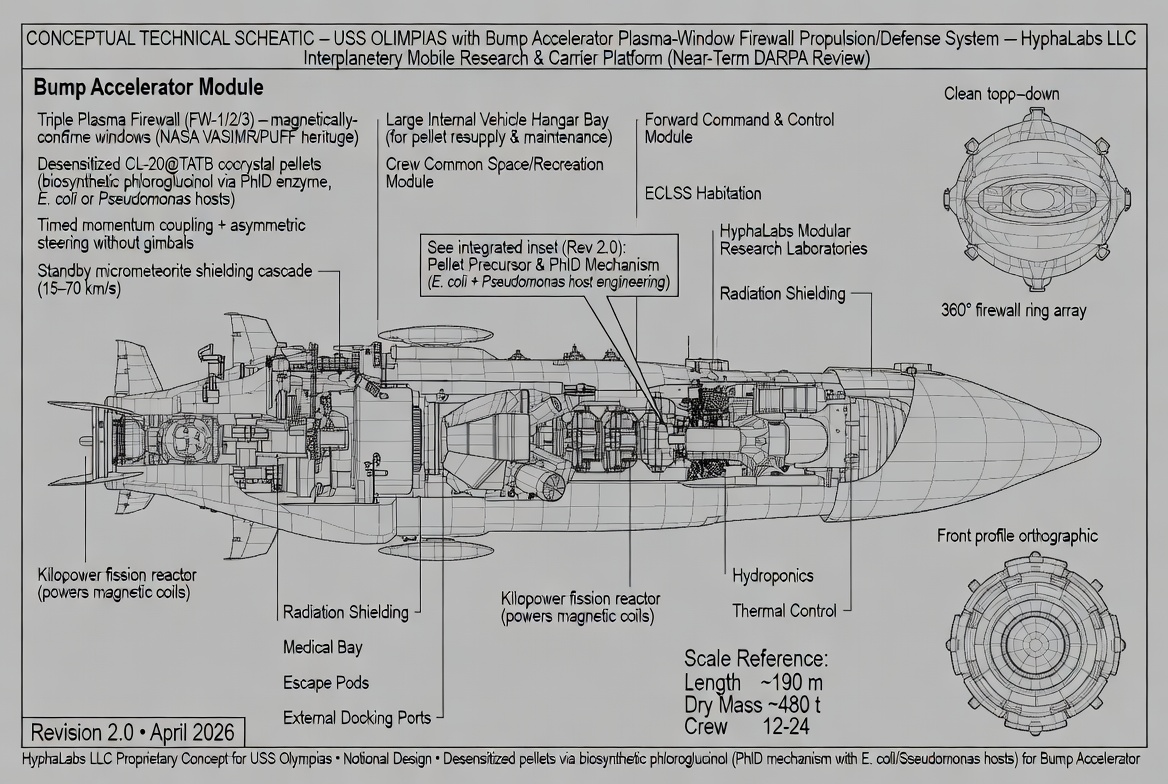
USS Olympias Rev 2.0 — Bump Accelerator Full Cutaway & Systems Layout
Hypha Labs LLC · Near-Term DARPA Review · April 2026
Hypha Labs Research Division · USS Olympias Technical Documentation · April 2026
The USS Olympias is a conceptual near-term interplanetary mobile research and carrier platform designed for NASA/DARPA review. At ~190m length and ~480t dry mass, it integrates Kilopower-derived fission reactors, the Bump Accelerator plasma-window propulsion/defense system, ISS-heritage ECLSS, HyphaLabs modular research laboratories, a large internal hangar bay, and full crew habitation for 12–24 personnel on multi-year missions. This design overview consolidates the Rev 2.0 architecture — ship layout, Bump Accelerator technical details, key system advantages, fusion plasma modeling connections, and the program heritage grounding the design in demonstrated technology.
Dual Kilopower-derived fission reactors power the magnetic coils and all ship systems. 10–15 year unattended operating life. Backup deployed solar arrays.
360° Triple Plasma Firewall (FW-1/2/3) provides both pulsed detonation propulsion and near-zero-mass micrometeorite defense at 15–70 km/s. NASA VASIMR heritage.
~480t dry mass, 12–24 crew. Large internal hangar bay, modular research labs, ECLSS habitation, hydroponics, and dedicated thermal control.
The USS Olympias is designed as an interplanetary mobile research and carrier platform — a ship that can transit the inner solar system, deploy and recover auxiliary craft, and conduct sustained multi-discipline scientific research throughout the mission. The Rev 2.0 design (April 2026) consolidates the platform around a Kilopower fission reactor cluster as its power backbone and the Bump Accelerator as its propulsion and defense system.
Unlike conventional spacecraft architectures that separate propulsion and defense into distinct system stacks, the Bump Accelerator's dual-use plasma firewall handles both simultaneously. When firing for thrust, the 360° plasma ring array provides directed momentum coupling from CL-20@TATB detonation events. In standby, the same ring operates as a passive micrometeorite cascade shield at 15–70 km/s — adding near-zero structural mass for what would otherwise require a separate dedicated defense layer.
The Rev 2.0 cutaway (top of page) identifies the primary internal zones fore to aft: Forward Command & Control Module at the bow; ECLSS Habitation and Crew Common Space / Recreation Module amidships; HyphaLabs Modular Research Laboratories and Radiation Shielding integrated into the mid-ship spine; the Large Internal Vehicle Hangar Bay for pellet resupply, maintenance, and daughtercraft operations; and the dual Kilopower fission reactors powering the magnetic coils aft. Hydroponics and dedicated thermal control systems round out the life-support envelope.
The ship uses a standby micrometeorite shielding cascade rated for impacts at 15–70 km/s — covering the threat range that exceeds conventional Whipple bumper performance alone. The plasma pre-processing stage ablates and decelerates incoming particles before the mechanical Whipple layer, significantly reducing the required Whipple mass for the same protection envelope.
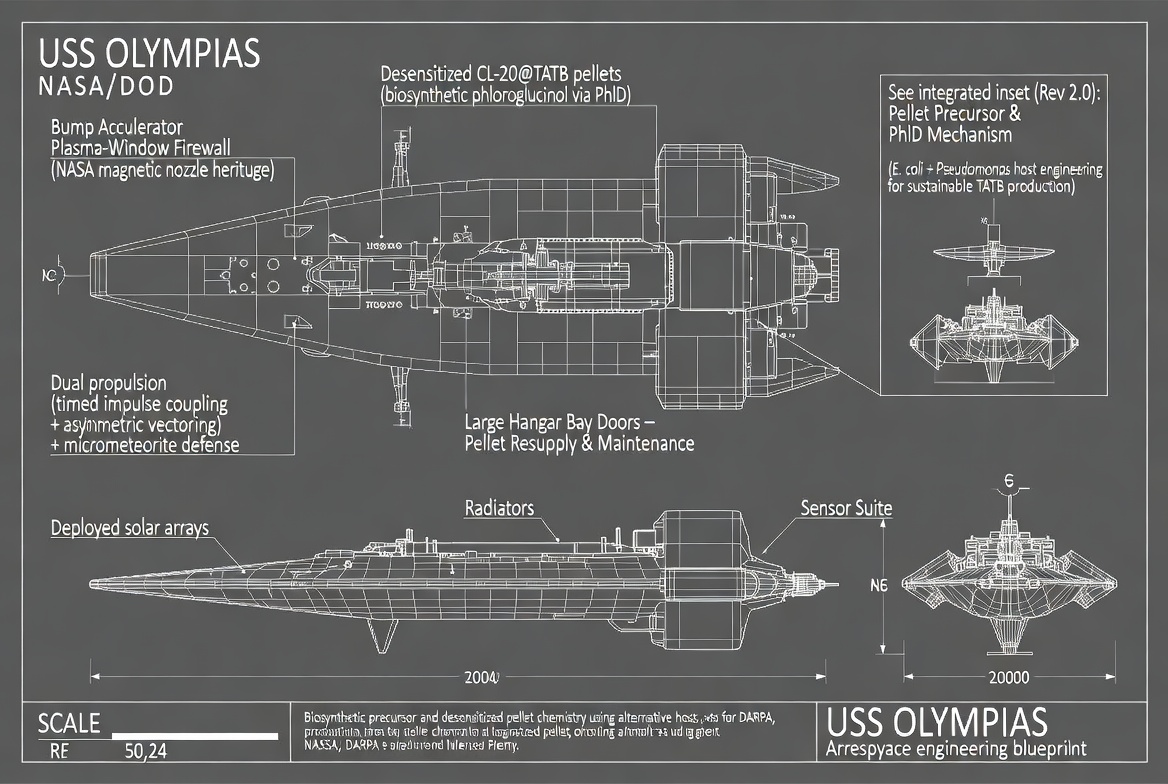
The orthographic blueprint presents three canonical views of the Rev 2.0 hull. The top-down view shows the Bump Accelerator module at the bow, large hangar bay doors at mid-ship, and deployed solar arrays flanking the aft section. The side profile shows the clean aerodynamic taper from forward command section through the mid-ship hangar to the radiator-heavy propulsion aft, with the sensor suite at the bow. The front profile reveals the 360° firewall ring array — the distinctive circular plasma-window mount that defines the bow-on appearance of the USS Olympias and provides the full-coverage micrometeorite defense field.
The Bump Accelerator is the propulsion and defense heart of the USS Olympias — a pulsed detonation system that uses magnetically-confined plasma windows as the momentum coupling interface, eliminating the rigid nozzle and its associated thermal fatigue, erosion, and mass penalties. The concept draws on NASA VASIMR magnetic nozzle heritage and DARPA's Pulsed Fission-Fusion (PuFF) program.
The Triple Plasma Firewall consists of three independently controlled plasma window chambers — FW-1, FW-2, and FW-3 — arranged around the aft hull in a 360° ring configuration. Each window is a magnetically-confined high-temperature plasma boundary maintained by superconducting coils powered by the Kilopower reactor cluster. The architecture draws on the NASA VASIMR magnetic nozzle heritage and Hershcovitch (1995) plasma window physics.
Each window is semi-permeable to momentum: the dense magnetized plasma couples the shock front from a pellet detonation event to the vehicle (propulsion) while allowing time-averaged exhaust products to diffuse through and vent aft. There is no contact between propellant products and any solid nozzle surface — eliminating erosion, thermal fatigue, and active cooling requirements entirely.
The plasma window is the insight. One architecture — three functions: momentum nozzle, radiation shield, and micrometeorite defense. That mass efficiency is why this design exists.
Pellets consist of desensitized CL-20@TATB cocrystal — combining CL-20's class-leading energy density (~15% higher than HMX) with TATB's exceptional shock insensitivity. The molecular-level cocrystal structure (Bolton & Matzger, 2012) transfers TATB's handling safety profile to the CL-20 host lattice, making the pellets vacuum-stable and safe for spacecraft handling in the vibration and microimpact environment of deep space transit.
Pellet mass range 0.1–10g enables adjustable pulse rate across a wide specific impulse band. The biosynthetic phloroglucinol (PG) precursor route via PhlD enzyme provides a sustainable, chlorine-free synthesis pathway — and opens the possibility of on-mission pellet resupply from biological feedstocks during long-duration missions. Full PhlD mechanism →
Symmetric firing: all three windows active for maximum thrust. Asymmetric sector firing: differential window activation and pellet detonation offset produce any thrust vector in the aft hemisphere — full 6-DoF attitude control without gimbals. Braking uses same system in reverse sector configuration — no separate retro-propulsion required.
When not actively firing, the 360° plasma ring remains energized in standby as a passive micrometeorite cascade shield. Plasma ablation (Stage 1), magnetic deceleration (Stage 2), and Whipple bumper absorption (Stage 3) address the full 15–70 km/s threat range. Near-zero added mass versus dedicated-shield architectures.
Combines the high specific impulse efficiency of nuclear-electric architectures with the high-impulse maneuverability of pulsed propulsion. Adjustable pulse rate lets operators trade Isp against thrust level in real time — something static NEP systems cannot do.
Nuclear Thermal Propulsion (NTP) requires cryogenic hydrogen propellant, produces significant vibration, and faces corrosion from hot hydrogen in contact with reactor materials. The Bump Accelerator uses solid pellets at ambient temperature until detonation — no cryogenic infrastructure, no continuous hot hydrogen flow, no reactor erosion.
The plasma window regenerates automatically after each detonation event — no mechanical components to reset, no worn nozzle throat to replace. Reduces maintenance mass, mission logistics, and single-point failure risk compared to mechanical nozzle architectures.
The internal vehicle hangar bay supports pellet magazine resupply, daughtercraft operations, EVA equipment maintenance, and orbital transfer vehicle staging — all from a pressurized environment. The ship functions as a true interplanetary carrier, not just a transit vehicle.
Full 6-DoF attitude control via asymmetric sector firing of the three plasma windows. Eliminates gimbals as a mechanical failure point, reduces mass, and removes the alignment complexity of physical engine rotation on a 190m-class platform.
While CL-20@TATB provides the highest energy density, the plasma window coupling physics is compatible with any solid propellant that can be pelletized and detonated — enabling mission-specific optimization or on-mission propellant substitution if needed.
The Bump Accelerator's plasma windows occupy the same physical regime as the scrape-off layer (SOL) and edge plasma of tokamak fusion reactors — a boundary region where hot plasma interfaces with material surfaces through a combination of magnetic confinement, neutral gas buffering, and particle-energy exchange. The physics toolkit developed for ITER, SPARC, and other fusion programs directly applies to modeling the Bump Accelerator's plasma window transients.
This is not an analogy — it is the same governing equations. The two-fluid MHD formulation (separate electron and ion fluid equations) used in fusion edge codes captures the charge-separation effects critical to plasma window stability. The same numerical frameworks — NIMROD, BOUT++, SOLPS-ITER — can model both tokamak SOL behavior and the plasma window response to pellet detonation shock fronts.
Magnetic reconnection events, drift-wave turbulence, and the sharp temperature gradients at the plasma boundary are all present in both tokamak edges and plasma windows. The Bump Accelerator's firewalls can be studied as a novel experimental platform for edge plasma physics — a geometry that current fusion programs have not yet explored.
Tokamak disruption events and ELMs (Edge-Localized Modes) involve sudden energy releases against the confining magnetic boundary — structurally analogous to a pellet detonation coupling through a plasma window. The validated disruption response models in NIMROD and BOUT++ provide a direct starting point for Bump Accelerator transient simulations.
The key insight: the Bump Accelerator benefits from decades of borrowed credibility. The modeling tools from ITER, SPARC, and NIMROD/BOUT++ are validated against experimental fusion data. Applying them to a new plasma geometry (the Bump Accelerator firewall) means the numerics start from a position of established validation, rather than requiring ground-up code development. This significantly reduces the simulation risk in the early program phases. Full MHD modeling methodology is detailed at MHD Modeling →
The USS Olympias design is grounded in a rigorous MHD modeling hierarchy matched to the physical phenomena at each scale. Ideal MHD captures global equilibrium and stability. Resistive and two-fluid MHD models plasma window transients where finite resistivity and charge separation dominate. Hall MHD extends into the sub-ion-scale dynamics relevant to the thin plasma boundary layer at the window edge.
NASA's Variable Specific Impulse Magnetoplasma Rocket demonstrated radio-frequency plasma heating and magnetic nozzle confinement for continuous thrust — the foundational magnetic confinement architecture that the Bump Accelerator adapts to the pulsed-detonation context.
The 2018 KRUSTY ground demonstration validated Kilopower fission reactor technology at 1–10 kWe for space applications. USS Olympias uses a cluster of KRUSTY-derived units as the primary power source for the magnetic coils and all ship systems.
The DoD PuFF (Pulsed Fission-Fusion) program investigated pulsed high-energy events against magnetically-confined plasma boundaries for thrust generation — the Bump Accelerator replaces the fission-fusion pulse with chemical-explosive (CL-20@TATB) events while preserving the plasma-coupling physics.
Validated two-fluid MHD codes from the fusion program apply directly to plasma window transient modeling. The Bump Accelerator plasma windows occupy the same physical regime as the scrape-off layer in tokamak reactors — enabling immediate use of established validated numerics.
Contemporary CFD-FSI (Computational Fluid Dynamics – Fluid-Structure Interaction) and MHD simulation workflows provide the framework for coupled multi-physics modeling of the Bump Accelerator's detonation, plasma coupling, and structural response. Full derivations at MHD Modeling →
Foundational demonstration that a 1-atmosphere plasma window can separate vacuum from atmospheric pressure across a 3mm plasma layer sustained at ~15,000 K. Scales to spacecraft dimensions with superconducting coil support — the core enabling physics for the Bump Accelerator firewall boundary.