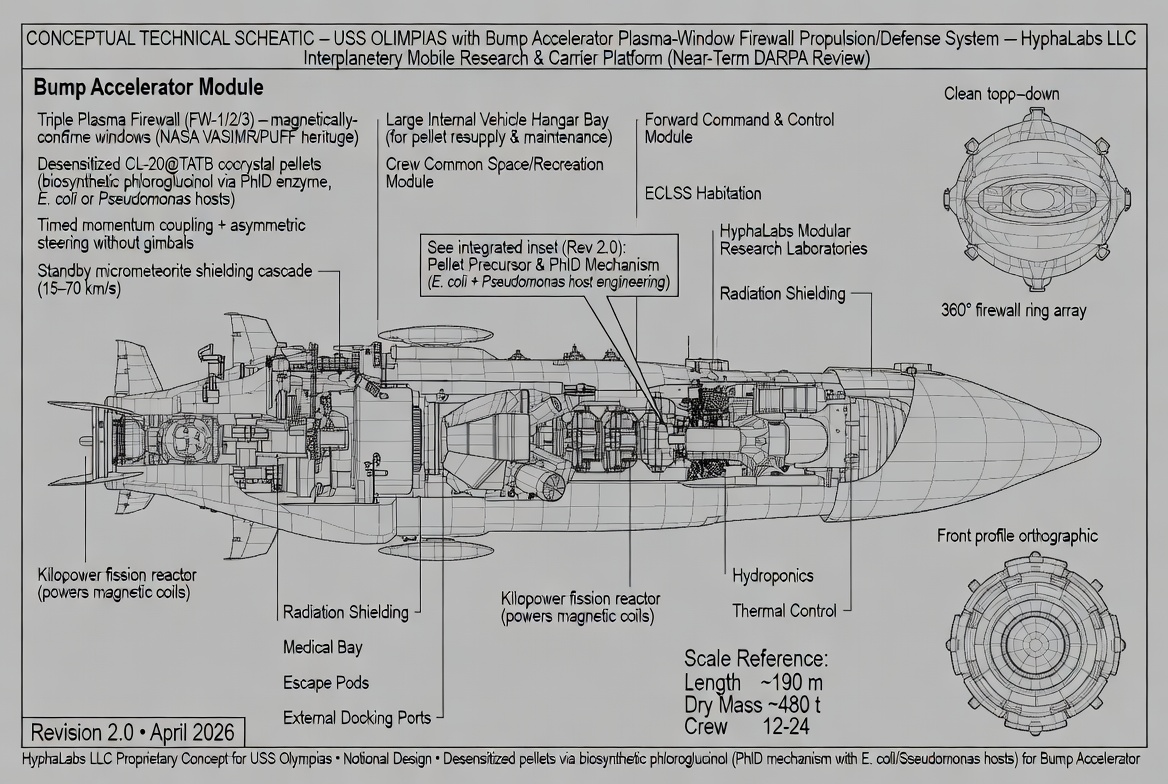
USS Olympias Rev 2.0 — Bump Accelerator Full Cutaway
Hypha Labs LLC · Near-Term DARPA Review · April 2026
Hypha Labs Research Division · USS Olympias Technical Documentation · April 2026
The Bump Accelerator is a hybrid in-space propulsion and passive defense system that uses timed detonation of desensitized CL-20@TATB cocrystal pellets against a triple magnetically-confined plasma firewall array. Drawing on NASA VASIMR magnetic nozzle heritage and the DoD PuFF (Pulsed Fission-Fusion) program, the plasma windows provide semi-permeable momentum coupling — converting pellet detonation impulse into directed thrust while allowing exhaust products to vent. In standby mode, the identical 360° firewall ring array serves as a near-zero-added-mass micrometeorite shield, dissipating hypervelocity impacts (15–70 km/s) through staged deceleration and ablation. Asymmetric sector firing enables gimbal-free full 6-DoF attitude control and steering without moving mechanical parts.
Conventional chemical rockets expand propellant through a rigid convergent-divergent nozzle. The nozzle is the bottleneck: it constrains expansion geometry, requires active cooling, and creates a heavy mechanical component at the hottest point in the propulsion system. The Bump Accelerator eliminates the rigid nozzle entirely by replacing it with a magnetically-confined plasma window — a semi-permeable barrier maintained by high-temperature plasma sustained in a magnetic bottle.
When a CL-20@TATB pellet detonates in the combustion zone forward of the plasma firewall, the explosion's shock front encounters the plasma window. The dense, magnetized plasma acts as a pressure-coupling interface: it transmits a significant fraction of the detonation momentum to the vehicle while allowing the lower-pressure exhaust products to diffuse through and vent aft. The result is directed thrust without contact between propellant products and any solid nozzle surface — no erosion, no active cooling, no thermal fatigue.
The plasma window is the insight. It is simultaneously the nozzle, the radiation shield, and in standby mode, the micrometeorite defense system — three functions in one zero-moving-part architecture. That mass efficiency is why this design exists.
The concept draws on work by Hershcovitch (1995) demonstrating that a 1-atmosphere plasma window can separate vacuum from atmospheric pressure across a 3mm-thick plasma layer sustained at ~15,000 K. Scaled to spacecraft dimensions with superconducting coil support, the same physics enables a plasma boundary that is effectively "solid" to a fast-moving shock front but "transparent" to the time-averaged exhaust flow.
The USS Olympias uses three discrete plasma firewall windows — FW-1, FW-2, and FW-3 — arranged in a 360° ring array around the aft hull. Each window is an independently powered, independently controllable plasma chamber. The superconducting magnetic coils that confine each window are powered by the onboard Kilopower fission reactor.
The three-window architecture is not redundancy for its own sake. It enables asymmetric sector firing: by adjusting the plasma density and magnetic confinement of individual windows while controlling pellet detonation timing and offset position, the system can direct thrust vectors in any direction in the aft hemisphere without physically rotating any engine component. Steering, braking, and attitude control all derive from differential sector control of the three windows.
NASA's VASIMR engine demonstrated radio-frequency plasma heating + magnetic nozzle confinement for continuous thrust. The Bump Accelerator adapts this magnetic confinement architecture to the pulsed-detonation context — using the plasma as a momentum-coupling interface rather than the propellant itself.
The DARPA/DoD PuFF program investigated pulsed high-energy events against magnetically-confined plasma boundaries for thrust generation. The Bump Accelerator replaces the fission-fusion pulse with chemical-explosive (CL-20@TATB) pulses — near-term feasible without nuclear infrastructure while preserving the plasma-coupling physics.
CL-20 (hexanitrohexaazaisowurtzitane, HNIW) is among the highest energy density conventional explosives known — approximately 15% higher specific energy than HMX and significantly higher than RDX or TNT. Its primary operational limitation is sensitivity: raw CL-20 is too shock-sensitive for reliable handling in spacecraft environments where vibration and micrometeorite impact are constant concerns.
The CL-20@TATB cocrystal formulation directly addresses this. TATB (triaminotrinitrobenzene) is one of the most thermally stable and shock-insensitive high explosives ever synthesized. Cocrystallizing CL-20 with TATB at the molecular level — rather than simply blending them — transfers TATB's insensitivity characteristics to the CL-20 host lattice. The result: a pellet with CL-20's energy density but TATB's handling safety profile.
The cocrystal formulation has been demonstrated in research contexts. A 2012 study in Crystal Growth & Design by Bolton and Matzger confirmed that CL-20@TATB cocrystals exhibit dramatically reduced sensitivity compared to pure CL-20 while retaining the majority of its detonation energy. The Bump Accelerator's pellet design builds directly on this work.
Traditional rocket engines steer by physically rotating the engine bell (gimbal steering) or by differential throttling of multiple engines. Gimbals introduce mechanical complexity, failure modes, and mass. Differential throttling wastes propellant for attitude control.
The Triple Plasma Firewall system eliminates both. Because FW-1, FW-2, and FW-3 are independently controllable, and because pellet injection position and timing are software-controlled, the Bump Accelerator can produce any thrust vector in the aft hemisphere by:
Braking maneuvers use the same system operating in reverse sector configuration — firing against the forward velocity vector to decelerate without requiring a separate retro-propulsion system. This is a direct mass reduction: no separate thruster set for deceleration.
When the Bump Accelerator is not actively firing for propulsion, the plasma firewall windows remain energized in standby configuration — now functioning as a 360° passive micrometeorite shield. The same physics that makes plasma windows effective at coupling detonation momentum also makes them effective at decelerating and ablating hypervelocity microparticles.
Micrometeorites in the relevant size range (100 μm to 1 cm) traveling at 15–70 km/s carry kinetic energies sufficient to penetrate conventional hull materials. The USS Olympias' shield cascade addresses these threats through staged mechanisms:
The key mass advantage: the plasma firewall itself has near-zero added structural mass for shielding purposes. The plasma is generated by the same coils that power the propulsion mode. The only additional mass is the Whipple bumper layers — which are significantly thinner (and lighter) than the equivalent Whipple system designed for unassisted operation, because the plasma pre-processing reduces the kinetic energy budget that the bumper must handle.
Hypha Labs Research Division · USS Olympias Technical Documentation · April 2026
For technical inquiries, program manager briefings, or collaboration — contact us directly.