USS Olympias — Interplanetary Mobile Research & Carrier Platform
HyphaLabs LLC Concept · NASA/DoD Aligned
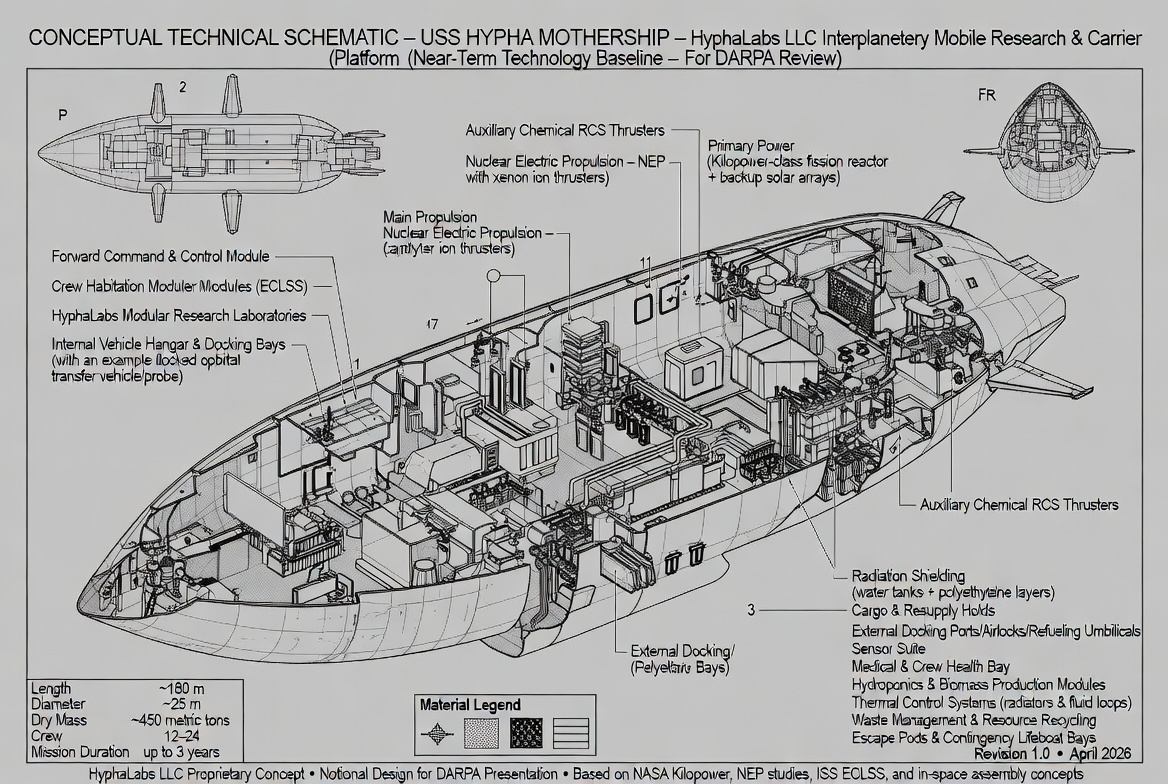
The space counterpart to the USS Hypha submarine and MBT Hypha tank. A near-term conceptual interplanetary mothership grounded in demonstrated NASA and DARPA technologies — Kilopower fission reactors, Nuclear Electric Propulsion, ISS-derived ECLSS, and modular in-space assembly. Designed for long-duration interplanetary research operations with full carrier capabilities for deploying and recovering smaller vehicles, probes, and orbital transfer craft.
~10 primary structural segments enable modular in-orbit assembly, bypassing launch fairing constraints entirely. Onboard HyphaLabs modular research laboratories extend the mission from carrier to active science platform — conducting microgravity biology, mycelium materials science, and ISRU experiments throughout transit.
Xenon ion thrusters powered by the Kilopower reactor cluster. 2,000–9,000+ s specific impulse for efficient interplanetary transit — a 10–30× improvement over chemical rockets. NASA SEP heritage →
KRUSTY-derived fission reactor cluster provides continuous multi-kWe output for 10–15 years. Backup solar arrays for low-power contingency ops. NASA Kilopower →
~10 primary structural segments launched separately and assembled in orbit — no single heavy-lift constraint. Enables a ~180m platform on existing launch vehicles.
Kilopower-powered xenon ion thruster array. Specific impulse 2,000–9,000+ s — 10–30× higher than chemical propulsion. Enables interplanetary transit on a fraction of the propellant mass. Demonstrated technology: NASA's SEP and NEXT-C ion thruster programs. NEP extends this with nuclear rather than solar power — eliminating the solar array scaling problem at Mars and beyond.
Multiple NASA Kilopower (KRUSTY-derived) fission reactors provide continuous multi-kWe output. Stirling engine conversion, low enriched uranium fuel, 10–15 year unattended operating life. Backup solar arrays for contingency ops near the inner solar system. The KRUSTY ground demonstration validated this architecture at 1–10 kWe — directly scalable to the multi-kWe array needed to drive the NEP thrusters and ship systems simultaneously.
Environmental Control and Life Support System based on NASA ISS ECLSS heritage. 90%+ water reclaim (WRS), CO₂ scrubbing (CDRA), O₂ generation (OGA), trace contaminant control. HyphaLabs' dark oxygen electrolysis and fungal bioelectricity research provides autonomous biological fallback systems that extend mission self-sufficiency without consumable resupply.
Closed-loop hydroponics bays with LED grow lighting and recirculated nutrients enable on-mission food production throughout multi-year transit. HyphaLabs fungal substrate integration adds mycelium-based food production alongside crops — addressing NASA's Advanced Food Technology requirement for missions beyond 400-day resupply windows. Produces supplemental O₂ as a byproduct of plant respiration.
~10 primary structural segments launched separately on existing heavy-lift vehicles and assembled in low Earth orbit — bypassing launch fairing constraints entirely. Each segment is self-contained with docking interfaces, power buses, and redundant data links. Assembly follows ISS assembly heritage. Final assembled length ~180m would be impossible as a single-launch configuration.
Reconfigurable mid-ship research modules compatible with NASA EXPRESS rack heritage dimensions. Supports microgravity biology experiments, mycelium composite fabrication, ISRU testbeds, and materials science. Rapid-changeover module frames allow different scientific payloads for each mission segment. HyphaLabs' core research — synthetic flesh, fungal composites, EM bio-armor — all generate new data in microgravity and reduced-gravity environments.
Full-width pressurized hangar bay for auxiliary vehicles, drones, EVA suits, and small landers. Supports carrier operations: deploying and recovering probes, orbital transfer vehicles, and surface explorers. Automated handling systems for EVA equipment and propellant logistics. Enables the USS Olympias to function as a true carrier platform, not just a transit vehicle — deploying scientific and operational assets throughout the mission.
Dedicated medical facility for 12–24 crew on multi-year missions. Autonomous surgical assist, telemedicine uplink (delayed relay for deep-space), and onboard pharmaceutical production via bioreactors. HyphaLabs' fungal biology research directly applicable: antimicrobial compound production, wound dressing biomaterials, and mycelium-derived pharmaceutical precursors for sustained missions where Earth resupply is infeasible. Radiation monitoring integrated with ECLSS.
Crew habitation modules shielded from both Kilopower reactor radiation and deep-space galactic cosmic rays (GCR). HyphaLabs' radiotrophic fungal biomass panels — validated on the ISS for radiation absorption — provide structural shielding at 10–20× lower mass than lead equivalents. Polyethylene storm shelters for solar particle events (SPE). Active magnetic shielding research ongoing for longer-duration configurations.
Bow-mounted command module with redundant sensor arrays, high-gain comms antenna, and autonomous operation capability. Deep-space communications relay via NASA SCaN network. Manned and unmanned operation modes. Integration with DoD Space Force C2 architecture for cislunar domain awareness interoperability. Forward positioning provides unobstructed sensor coverage and protects crew from reactor and thruster emissions aft.
A ~180m ship cannot be launched on any existing or near-term vehicle as a single unit. The USS Olympias solves this through the same approach used for the ISS: modular segments launched individually and assembled in low Earth orbit, then boosted to departure orbit for the interplanetary transit. Each segment is designed for robotic or astronaut assembly with standardized docking interfaces and power buses.
Crew command deck, primary sensors, docking ring for inter-segment assembly. First segment launched — serves as assembly hub.
Crew quarters, ECLSS hardware, medical bay, exercise equipment. Two modules provide redundant life support and expanded crew capacity.
Modular lab frames in EXPRESS-compatible dimensions. Configurable for mission-specific scientific payloads and experiments.
Hydroponics bays, recreation area, food production systems. Mid-ship placement for radiation shielding contribution from surrounding modules.
Pressurized hangar for auxiliary vehicles and EVA equipment. Large pressurizable bay with automated handling and docking fixtures.
Fission reactor cluster with radiator panels. Aft-positioned to maximize crew separation from radiation source. Thermal radiators deploy post-assembly.
Ion thruster cluster, propellant tanks (xenon), gimbal mounts. Final segment attached after reactor integration — completes the propulsion stack.
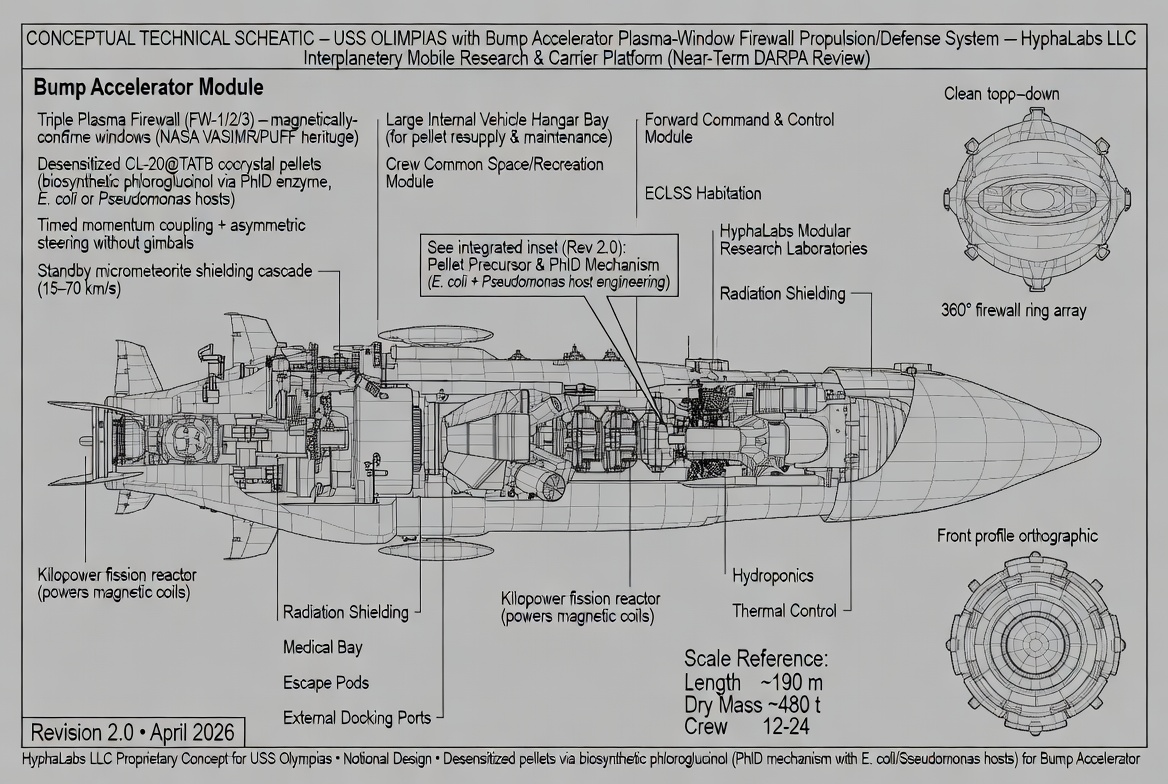
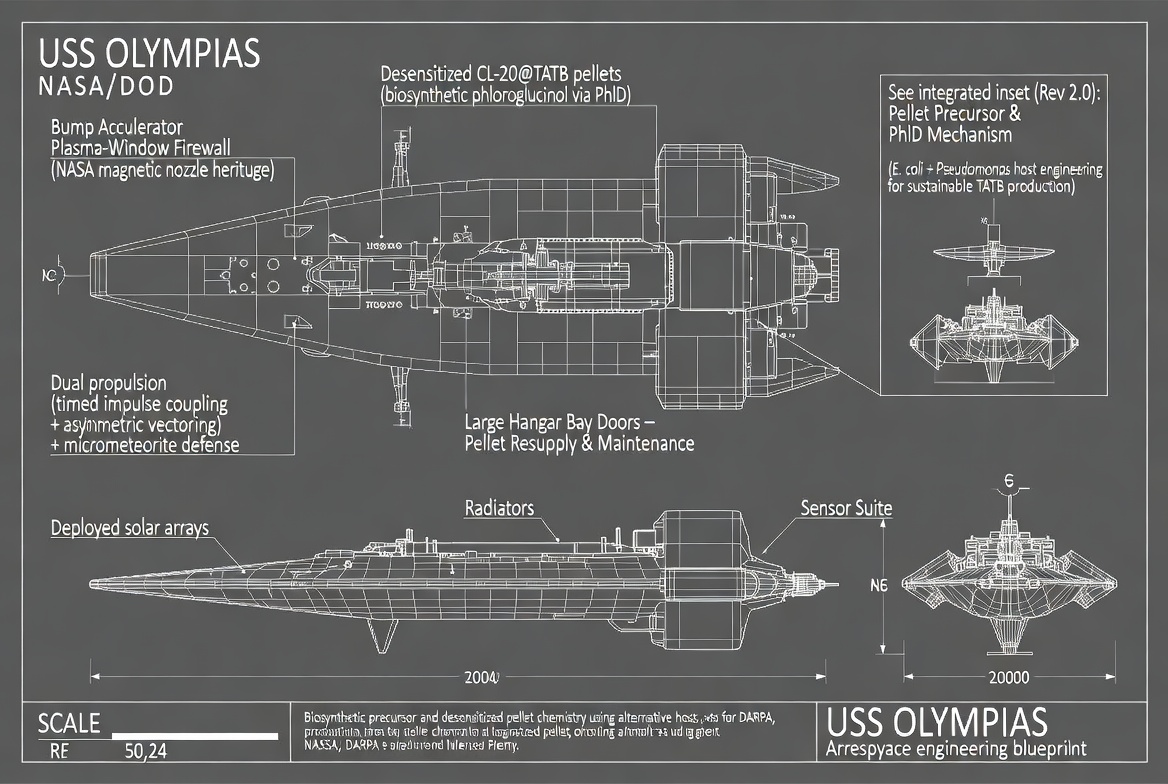
HyphaLabs is concurrently developing the Bump Accelerator as a longer-term propulsion concept — timed detonation of CL-20@TATB cocrystal pellets against a triple magnetically-confined plasma firewall (NASA VASIMR/PuFF heritage). If validated, the dual-use plasma firewall would provide both propulsion and a 360° micrometeorite shield in a near-zero-added-mass architecture.
USS Olympias Rev 2.0 — Bump Accelerator full cutaway (DARPA review)
Rev 2.0 consolidated architecture: ship layout, Bump Accelerator technical details, key system advantages, fusion plasma modeling connections, and full MHD/heritage grounding. Both Rev 2.0 schematics with full systems breakdown.
Read Overview →Full technical breakdown of the Bump Accelerator propulsion concept. CL-20@TATB pellet timed detonation, plasma window physics, momentum coupling theory, asymmetric sector firing for gimbal-free steering, and the staged micrometeorite cascade mechanism.
Read Deep Dive →Biosynthetic phloroglucinol route via PhlD (Type III polyketide synthase): malonyl-CoA loading, Claisen condensation, cyclization/aromatization, and TATB co-crystal desensitization of CL-20. Chlorine-free sustainable synthesis enabling potential on-mission pellet resupply from biological feedstocks.
Read Deep Dive →The NASA Kilopower program (KRUSTY test, 2018) demonstrated fission power at 1–10 kWe for space applications. USS Hypha uses a cluster of KRUSTY-derived units as the primary power and NEP source.
NASA's SEP program and NEXT-C ion thruster demonstrate the propulsion technology baseline. USS Hypha extends SEP to nuclear power, enabling higher thrust levels and operations far from the sun.
Two decades of ISS ECLSS operations validate the closed-loop life support architecture. 90%+ water reclaim and closed-loop O₂ generation are demonstrated, flight-qualified technologies.
ISS assembly established the operational playbook for modular in-orbit construction over 13 years of assembly flights. NASA ISS Assembly directly de-risks the USS Hypha segment-based construction approach.
DARPA's nuclear electric kick stage and cislunar domain awareness programs align directly with USS Hypha's NEP propulsion architecture and DoD carrier mission profile.
USS Hypha's carrier capabilities and forward C&C module align with USSF cislunar domain awareness requirements. High-Isp NEP enables responsive maneuverability for cislunar patrol and support missions beyond LEO.