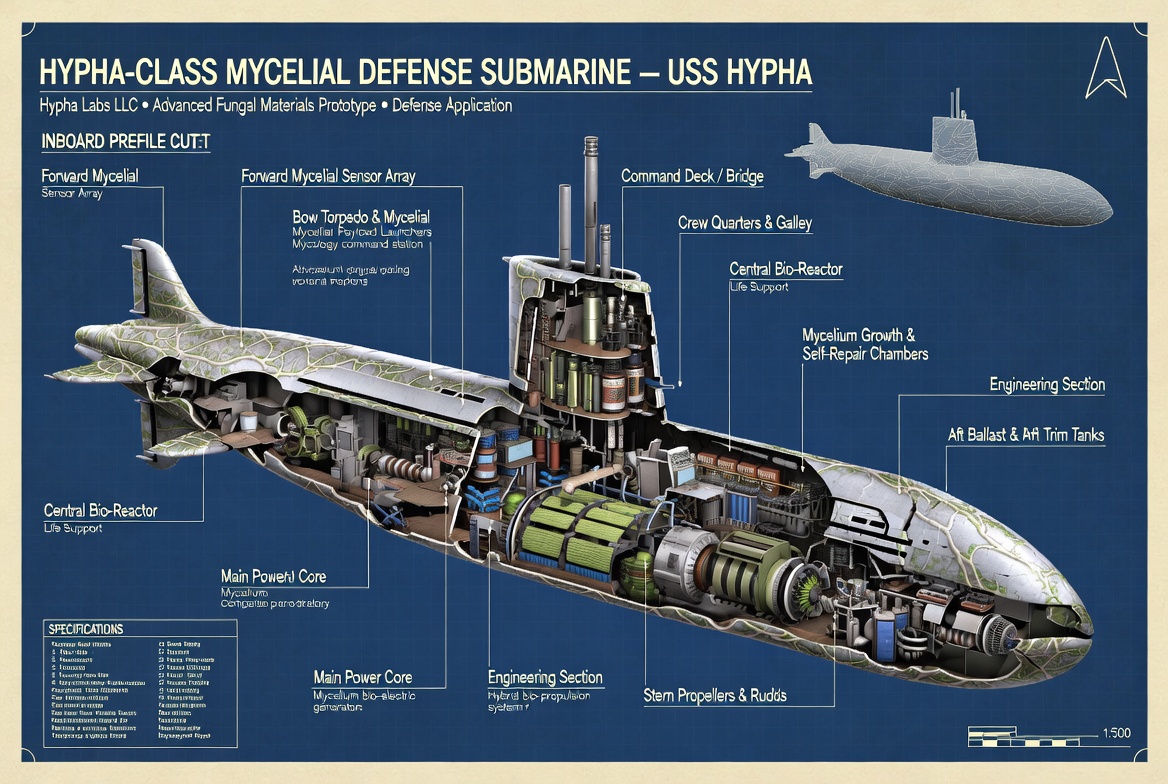
Fig. 1 — USS Hypha · Hypha-class Mycelial Defense Submarine · Cutaway Schematic
TRL 1–2 · Conceptual Design Phase
Hypha-class Mycelial Defense Submarine — USS Hypha. A next-generation undersea platform with a living mycelium composite pressure hull — grown in bioreactors, reinforced with nanomaterials, and self-repairing via active hyphal networks. Prototype design by HyphaLabs.
Mycelium composite pressure hull lighter than titanium, pressure-resistant to 4,500+ meters. Self-repairs micro-fractures through nutrient-fed hyphal networks — no dry-dock required.
Fungal neural networks function as ultra-sensitive passive sonar. Adaptive bio-camouflage changes hull texture and acoustic signature. Near-silent bio-magnetohydrodynamic propulsion.
Integrated mycelium bioreactors produce oxygen, recycle waste, and grow supplemental food. 18+ months submerged endurance without resupply — fully closed biological loop.
The USS Hypha is a prototype design concept for the world's first living-hull undersea vehicle. The pressure hull is not fabricated — it is grown. Engineered mycelium strains are cultivated in large-format bioreactors, guided by structural scaffolding, and reinforced in situ with ceramic nanoparticles and conductive metal nanocomposites. The result is a composite material that is lighter than titanium, acoustically dampening by nature, and structurally self-repairing through continuous metabolic activity maintained by a nutrient-delivery network embedded in the hull matrix.
Every major subsystem aboard the USS Hypha is biologically integrated — not mechanically bolted on. The hull grows, the sensors sense, the propulsion runs silent, and the life support is the hull. No separation between platform and biology.
Multi-layered mycelium composite grown in industrial bioreactors and cured with ceramic nanoparticle reinforcement. Embedded conductive hyphae provide passive EM shielding across all layers and bio-electric power generation from hull-integrated electroactive fungal biofilm. Density below 1.4 g/cm³ — lighter than aluminum, acoustically superior to steel.
Hull-integrated bioreactor modules produce breathable oxygen through dark electrolysis pathways, recycle CO₂ and waste streams into fungal substrate, and cultivate supplemental food biomass using metabolic byproducts. Closed biological loop: crew waste becomes hull nutrients. Rated for 18+ months continuous operation without external resupply.
Living fungal neural networks distributed across the hull interior function as ultra-sensitive passive acoustic sensors with frequency response from sub-1 Hz to 200 kHz. Adaptive bio-camouflage pigmentation system changes outer hull texture and color via mycelial actuation. No active acoustic emissions — purely passive, impossible to ping-locate.
Hybrid propulsion using mycelium-generated bioelectricity to power magnetohydrodynamic thrusters — no rotating shafts, no turbine noise, no cavitation. Electric current passed through seawater in magnetic field produces continuous thrust with near-zero acoustic signature. Secondary biological jet-propulsion vents for maneuver authority.
Hull-integrated fungal payload bays deploy smart bio-munitions and drone swarms on demand. Drone airframes can be grown to specification using onboard mycelium fabrication from local substrate. Payload modules self-seal and bio-repair after deployment. Operating range and payload capacity scale with mission endurance time.
Micro-fractures in the pressure hull trigger chemotropic response from dormant hyphal growth nodes seeded throughout the composite matrix. Anastomosis bridges gaps within hours for small damage events. Macro-damage triggers localized bioreactor surge — accelerated growth re-seals breaches in days without external maintenance.
Prototype design specifications for the Hypha-class at design displacement. All values represent engineering targets for the first-generation platform. Hull growth parameters and bioreactor integration ratios are under active development.
Conventional submarine propulsion — shaft-driven propellers — creates a distinct acoustic signature detectable at tens of kilometers. The USS Hypha uses no rotating machinery for primary propulsion. Mycelium-generated bioelectricity drives magnetohydrodynamic thrusters: seawater passes through a magnetic field with applied current, producing thrust through the Lorentz force.
The result is silent, shaftless propulsion with no cavitation signature, no vibration node, and no rotating-component failure modes. Primary power source is hull-integrated electroactive fungal biofilm supplemented by bio-fuel cells.
Passive sonar through fungal neural networks provides acoustic situational awareness without emitting a single detectable pulse. Fungal hyphae distributed across interior hull surfaces detect pressure waves across a frequency range that spans infrasound to ultrasound — broader than any current sonar array.
Adaptive bio-camouflage is not a coating — it is a living surface. Hull melanin and texture modulate continuously via mycelial actuation in response to ambient water temperature, pressure, and backscatter environment.
The Hypha-class addresses capability gaps across multiple Navy and joint-service undersea warfare requirements — particularly long-endurance, low-acoustic-signature platforms for sustained forward presence in denied environments.
Self-sustaining mycelium life support eliminates the endurance limitation imposed by consumables. Hypha-class platforms can operate in forward areas for 18+ months without resupply — enabling persistent ISR, undersea infrastructure monitoring, and forward deterrence at a fraction of current operational cost.
Bio-MHD propulsion eliminates the primary acoustic signature of conventional submarines. Passive-only sonar and living hull camouflage address DARPA objectives for undersea vehicles that are undetectable by current-generation ASW systems — a fundamental shift in submarine survivability.
ONR interest in bio-inspired and bio-hybrid platforms aligns directly with the Hypha-class's living hull, fungal neural sensing, and self-repairing structural composites. The platform serves as a test bed for bio-hybrid undersea system concepts with near-term component extraction into existing platforms.
4,500 m depth capability opens operational zones inaccessible to all existing platforms. Self-repairing hull reduces mission-aborting risk from microcrack propagation at depth. Mycelial bio-munition launchers and drone-grow capacity support SOCOM persistent-presence and direct-action requirements in deep environments.
Active hyphal self-repair reduces dry-dock maintenance cycles, the dominant cost driver in submarine fleet readiness. A hull that repairs micro-fractures autonomously — without port calls — improves operational availability for extended deployments in contested or remote areas.
The integrated mycelium life support system represents a dual-use research platform: undersea endurance and closed-loop habitat technology applicable to remote bases, subterranean facilities, and long-duration space missions. BARDA alignment through biological oxygen production and waste-recycling research.
We speak directly with DoD program managers, Navy acquisition officers, and joint-service evaluators. Classified and unclassified briefing formats available. Technical data only.