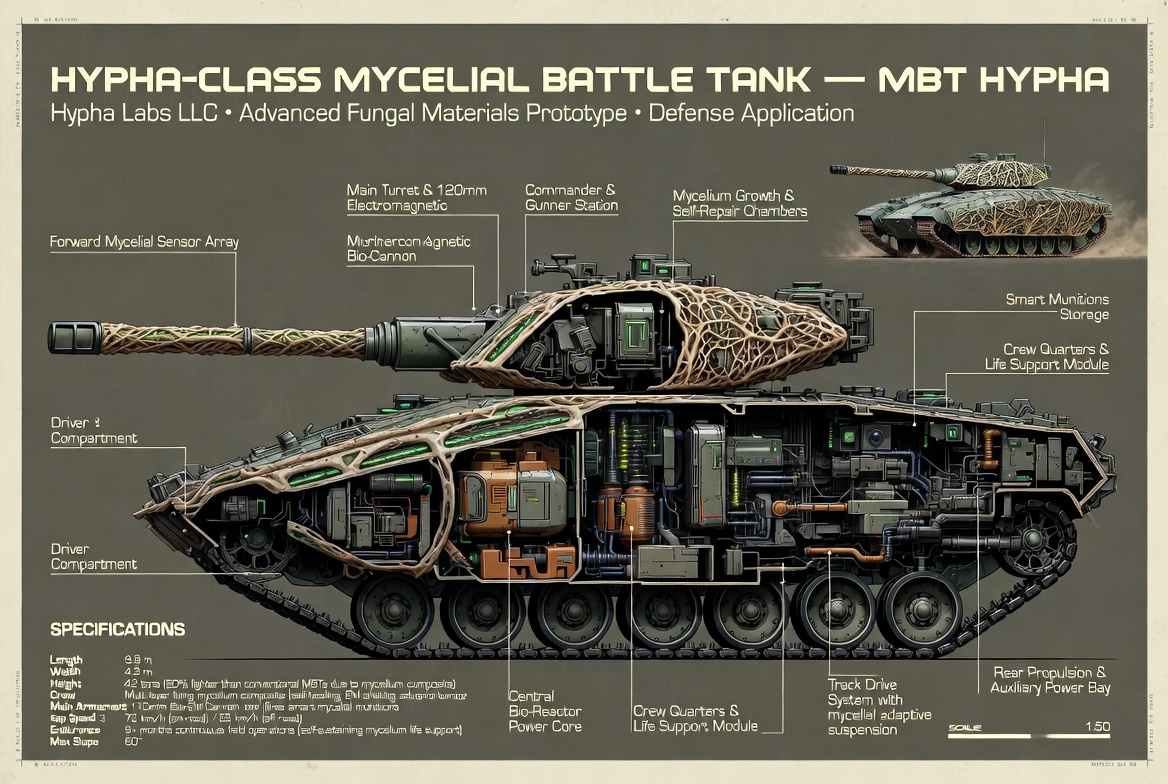
Fig. 1 — MBT Hypha · Hypha-Class Mycelial Battle Tank · Cutaway Schematic · Scale 1:50
TRL 1–2 · Conceptual Design Phase
Hypha-Class Mycelial Battle Tank — MBT Hypha. The ground-combat counterpart to the USS Hypha submarine. A next-generation main battle tank clad in living mycelium composite armor — 20% lighter than conventional MBTs, self-repairing via active hyphal networks, and self-sustaining through an integrated bio-reactor core. Prototype design by HyphaLabs.
Multi-layer mycelium composite hull 20% lighter than conventional MBTs. Passive EM shielding across all layers. Hyphae regrow damaged hull sections when fed nutrients — battlefield self-repair without maintenance facilities.
120mm electromagnetic main gun fires smart mycelial munitions that grow impact effects on target. Bio-integrated targeting via Forward Mycelial Sensor Array for enhanced detection and acquisition across all terrain.
Central Bio-Reactor Power Core sustains 9+ months of continuous field operations without resupply. Mycelial adaptive suspension enables silent, high-traction movement across any terrain — from 60° slopes to off-road at 52 km/h.
The MBT Hypha is a prototype design concept for the world's first living-armor main battle tank. The hull is not fabricated from steel — it is grown. Engineered mycelium strains are cultivated in large-format bioreactors, guided by structural scaffolding, and reinforced with ceramic nanoparticles and conductive metal nanocomposites. The result is a composite material that is 20% lighter than conventional MBT steel, passively EM-shielding, and structurally self-repairing through continuous metabolic activity maintained by a nutrient-delivery network embedded in the armor matrix. Paired with a Central Bio-Reactor Power Core, the MBT Hypha achieves 9+ months of sustained field operations without external resupply.
Every major subsystem aboard the MBT Hypha is biologically integrated — not bolted on. The armor grows, the sensors sense through mycelial networks, the cannon fires smart bio-munitions, and the bio-reactor sustains the crew indefinitely. No separation between platform and biology.
Multi-layer self-healing composite hull grown in industrial bioreactors and cured with ceramic nanoparticle reinforcement. Passive EM shielding across all layers via embedded conductive hyphae. Bio-electric power generation from hull-integrated electroactive fungal biofilm. 20% lighter than conventional MBT steel — same protection profile at reduced mass.
Dedicated mycelium growth chambers feed the armor matrix continuously. When battle damage penetrates hull layers, hyphae chemotropically respond to the fracture boundary — anastomosis bridges small gaps within hours. Macro-damage triggers localized bioreactor surge: accelerated hyphal growth re-seals breaches within days. No maintenance depot required for most field damage events.
Main turret fires smart bio-munitions via electromagnetic acceleration — no conventional propellant, no combustion signature. Smart mycelial munitions are pre-seeded with engineered hyphal growth strains that activate on impact, growing disruptive biological effects into the target structure. Multiple munition types available for anti-armor, anti-personnel, and infrastructure interdiction missions.
Supplemental power generation from mycelium bioelectrochemistry sustains all vehicle systems independent of fossil fuel logistics chains. The bio-reactor processes biological substrate and metabolic waste into electrical output and hull nutrients simultaneously. Sustains field operations for 9+ months continuously — redefining tactical endurance for ground platforms in denied-logistics environments.
Track drive system with mycelial adaptive suspension delivers silent, high-traction movement across any terrain. Mycelium composite track components provide vibration dampening beyond conventional rubber-steel assemblies, reducing acoustic signature and crew fatigue. Rated 72 km/h on-road, 52 km/h off-road, 60° max slope — matching or exceeding conventional MBT mobility with reduced logistics burden.
Bio-integrated sensing array fuses mycelial network signal detection with conventional sensor suites. Distributed hyphae across the forward hull detect pressure, thermal, and chemical signatures at ranges conventional sensors cannot match. Provides the Commander & Gunner Station with enhanced situational awareness in low-visibility, EMP-disrupted, and chemically contaminated battlefield environments.
Prototype design specifications for the MBT Hypha at design configuration. All values represent engineering targets for the first-generation platform. Armor growth parameters and bio-reactor integration ratios are under active development.
Every component visible in the schematic represents a biologically integrated system. From the forward sensor array to the rear propulsion bay, biology replaces or augments every conventional mechanical subsystem.
Conventional MBT suspension systems — torsion bars, hydrogas dampers, road wheels — create distinct acoustic and vibration signatures detectable at range. The MBT Hypha uses mycelium composite components throughout its track and suspension assembly, providing vibration dampening characteristics that exceed conventional rubber-steel assemblies.
The bio-reactor core supplements diesel power with mycelium-derived bioelectricity, reducing engine load requirements and acoustic output during low-speed tactical movement. The combination allows near-silent approach speeds in noise-sensitive operational environments.
The Forward Mycelial Sensor Array provides situational awareness beyond conventional optical and thermal sensors. Distributed hyphal networks across the hull exterior detect chemical signatures, pressure waves, and ground vibrations — inputs invisible to standard sensor suites.
The Commander & Gunner Station integrates mycelial sensor feeds with conventional targeting systems, providing enhanced target detection in degraded visibility, EMP-disrupted, or chemically contaminated environments where electronic sensors are compromised.
The MBT Hypha addresses capability gaps across Army, DARPA, and joint-service ground combat requirements — particularly long-endurance, low-logistics-burden platforms for sustained operations in denied-supply environments.
Self-sustaining mycelium life support and bio-reactor power eliminate the endurance limitation imposed by fuel and consumable logistics chains. MBT Hypha platforms can operate in forward areas for 9+ months without resupply — enabling persistent ground presence in denied-logistics environments at a fraction of current operational cost.
Bio-hybrid armor that self-repairs on the battlefield addresses DARPA objectives for autonomous maintenance reduction and platform survivability enhancement. The MBT Hypha's living armor directly aligns with DARPA's Materials for Transduction (MATRIX) and BioControl programs targeting self-repairing, adaptive defense materials.
9+ month endurance without resupply opens operational capabilities inaccessible to all existing MBT platforms. Reduced acoustic signature and bio-sensor persistence through EMP events support SOCOM ground infiltration and direct-action requirements in heavily contested environments where conventional logistics are impossible or compromised.
ARL interest in bio-hybrid and living material platforms aligns with the MBT Hypha's living armor, mycelial sensor networks, and self-repairing structural composites. The platform serves as a test bed for bio-hybrid ground system concepts with near-term component extraction into existing vehicle programs, including reactive armor panel replacements.
Active hyphal self-repair reduces depot maintenance cycles, the dominant cost driver in armored fleet readiness. A hull that repairs battle damage autonomously — without field maintenance teams — improves operational availability for extended deployments in remote or contested areas. Estimated 40–60% reduction in maintenance-driven operational pauses.
The integrated mycelium life support and bio-reactor system is a dual-use research platform: ground vehicle endurance and closed-loop habitat technology applicable to forward operating bases, underground facilities, and long-duration remote outposts. BARDA alignment through biological oxygen production and biological waste-recycling research applicable to battlefield medicine.
We speak directly with Army program managers, DARPA evaluators, and joint-service acquisition officers. Classified and unclassified briefing formats available. Technical data only.